Tuesday, August 16, 2011

Surefire Tips to Improve Your Golf Short Game

The short game, also called the pitch, is the most technical aspect of golfing. If you are good at the golf short game, you are likely to perform better and have a lower score. By following the golf short game tips below it can help you improve your golfing and ensure that it will take fewer strokes to complete the hole.

The short game is often ignored and people concentrate and practice the long game harder. The short game is hard because of the technicalities involved and takes up much more time to master. However, with these great tips, you will have no problem in stepping up a notch and becoming an expert golfer.

There are two type of pitches involved in the short game. These pitches depend on the distance that you are from the green. The further you are away from the pin the longer your swing will be. When you are around the fringe of the green that is when you will be chipping and that is outside of the scope of this article. In this article I will concentrate on pitches of 30 yards or less and those of 100 to 30 yards away.

You have taken the big swing and landed the ball within 100 yards of the hole. Now you need to take a swing at the ball. Here are the surefire tips for the short game that will help you get the ball closer to the pin.

Inside 30 Yards
For this pitch you want to assume a neutral grip. What I mean by a neutral grip is that when you look down at your hands as they grip the club you should be able to see two knuckles of the left hand (right hand for the left hander's). You should also be griping the club down at the end of the grip and close to the shaft.

For your stance you want to place your feet a little less than shoulder width apart and play the ball in the middle of your stance. Your hands should be a little ahead of the ball and you left (right for lefties) should be slightly pointed out about 25 to 35 degrees and the other foot about 10 to 15 degrees.

Your knees need to be flexed as you address the ball and your knees, hips and should should be perpendicular to the target. Your weight should be about 60 percent towards the left foot for right-handers and the opposite for the lefthanders.

For the standard pitch shot you want to bring the club back by cocking the wrists until the shaft of the club is parallel to the ground. Then you want to follow through until the shaft of the club is perpendicular to the ground. Remember the follow trough is important as it helps to make sure that the club head is acceleration through the ball.

The clubs you will use to this shot will vary with the circumstances. If you want a high pitch then you would use a wedge or another lofted club. For a low pitch you may want to choose a 7, 8, or 9 iron. You have to remember that the lower the pitch the more run you will get when the ball hits the green.

Inside 100 Yards
For this shot you will more than likely be choosing a wedge for a club. This club is ideal for this type of pitch. Wedges come in various degrees of loft so you need to practice to see which wedge you feel comfortable with for the distance you are at.

For this shot you are going to set up much like you did for the pitch shot 30 yards and under with a few exceptions. In order to get the required distance you are going to have to turn your body further and swing further. To accomplish this you should widen your stance to about your shoulder width and grip your club in the normal manner, more up towards the end of the grip. Your weight distribution should be equal or slightly to the back foot.

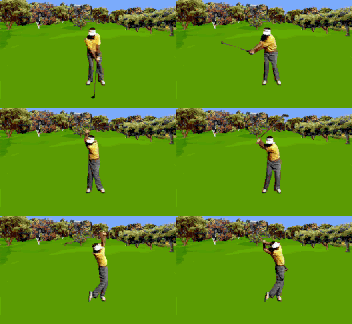
Once you have establish the address position you will simply need to turn and swing back until your arms are parallel to the ground and the club is perpendicular to the ground. From the backswing you want to turn and swing through in unison until the finish where you will find almost all of your weight on the front foot and the club above your head and parallel to the ground.

I feel that if you follow these tips on the short game that you will be able to reduce the number of strokes on your score card.

I hope that you have found these tips on the short game helpful and if you want please check out our site for golf tips and more to help you improve your golf game.
Visit http://www.ultimateseniorgolfer.com where you will find great tips and information for the senior golfer.

Wednesday, July 13, 2011

The Prerequisites For Attaining A Perfect Golf Swing

Having a perfect golf swing is a prime attribute of all of the top players in the sport. However it is not a piece of cake to refine the rhythm and swing every time at a tempo that is consistent. Not only that, but there is a perpetual state of balance that is achieved through a lot of practice.

There is an ineluctable link between rhythm and balance. There are players like Tom Watson who have much quicker tempos. On the other hand, one sees players like Ernie Els who play with a slower tempo. Whatever the case, there is equilibrium between their tempo and rhythm, which ensures a perfect golf swing.

The smoothness of pace and the maintenance of balance is what can help a player to attain lasting consistency with their swing. There are some mistakes that should be avoided by a golfer if he wants to perfect his art. One of them is rushing the swing, which leads to inconsistent contact as well as poor ball flight. Those who are extraordinary in the sport of golf do not lose their balance with a few exceptions, of course.

As it is, no one is perfect and even in the sporting careers of some of the best players there are some low moments. Their positions and movements are linked by their natural cadence. A golf swing by a seasoned pro generally seems effortless as one expert describes the approach in the words "swing easy and hit hard." The proper sequence of the body movement enables one to reach a posture of leverage and power. Calvin Peete, being a ten-time PGA Tour driving accuracy champion presents the success factors behind straight driving - balance, balance and more balance.

Achieving consistency is only possible if understanding is acquired about how the body gets its balance in the respective vital positions. The weight should be balanced between the right and left foot with the support of the player's middle and long irons, even while the spine is curved away from the target of focus. There should be no specific pressure on one particular heel or toe. As it is, on this level also attaining the right magnitude of balance is imperative and that is accomplished by a movement of the balls of the feet.

When the player arrives at the impact point, the majority of the weight should be transferred to the front foot. With the head positioned behind the ball and the hips shifting forward about four inches past their original position, the spine tilt is increased to twice its original angle. In short, propriety and coordination is what is required in the course of achieving this target that can only be attained by a lot of practice and hard work.
Are you looking for the tips for driving in golf? Be sure to visit my site for tips on getting straighter drives.

Thursday, July 7, 2011

Tips On How To Improve Your Golf Chipping

The short game is very important, as most golfers know. In this article you will find plenty of short game tips to help your golf chipping.

Around the greens you will find a few different approaches to golf chipping and type of shot to be executed. There are many ways and techniques to learn around the greens, not just one method. There are a few variables to take into consideration that can affect the outcome of your chipping and they are, your lie, the surface condition and also distance from the target.

We will begin our tips on golf chipping with the basic chip. This chip is executed from just off the green. Your clubs of choice for this type of chip are the wedges or an 8/9iron. The best tactic for a simple chip is to choose the club that will let the ball run out to the hole for at least two thirds of the way. You should play this shot from an open stance with the ball position more towards your back foot, weight forward and hands ahead of the ball.

Our next golf chipping tip takes a look at the flop shot. When executed correctly your intention is to loft the ball through the air landing softly with little run. Most of the time a lob or sand wedge is used to help with the height required to pull off this type of shot.

With the flop shot you need to open the club face a bit. Keep your hands behind the club head with the ball positioned off of your front foot for this swing. Accelerating the club head through impact is vital to the success of this shot. A short, high flight with the ball nestling softly by the hole side with little or no run can be achieved when performed correctly.

A low chip and run is needed when you have a lot of green to cover before reaching the hole. Better to use longer irons for this like a 3/4/5/6 or 7 iron. A downward strike on the ball is needed for a crisp strike and consistency, so position the ball back in your stance. Once again you should align the clubface to the target and keep your hands ahead through impact.

The important thing here is the ball is rolling most of the way with this type of chip, so you have more control and will be able to judge the distance better.

The best thing to come from all these golf chipping tips is the need to practice with every iron in the bag if you want to become a better golfer around the greens. As with all golf skills it is important to get out there on the practice range or golf course and work on them until you become proficient.

Lower scores can be achieved if you become skilled in the short game area. Put these golf chipping tips to good use to enjoy lower scores and hopefully reduce your handicap along the way.

Kevin Phillips is a Golf Professional, and the Head Pro at Winterfield Golf Club on the East Coast of Scotland. He has written and published numerous golf articles. Visit his Golf Club Website ==>> http://www.winterfieldgolfclub.info - You will find more invaluable advice, tips and resources at the 2nd home of golf -->> kpgolfpro.com where you can also get a FREE report on how to become a better golfer as well as a free subscription to his golf newsletter.

Tuesday, July 5, 2011

How to Improve Your Short Game in Golf - Playing a Par 3 Course

Learning how to improve your short game in golf is by far the most important thing you can do to shoot a low round and improve your golf game. Amateur Golfers will play between 20 and 30 shots inside of 150 yards every round.

I watch so many people on the golf course struggle with their short game. Oh they will hit the green, but most of the time they are looking at long putts for birdie or par.

There are a couple of par 3 golf courses where I live and I love to play them on a pretty regular basis. My golf buddies laugh at me and think I am crazy. They tell me that I am wasting my time.

I know that understanding how to swing a wedge golf club will improve my golf swing technique faster than hitting a thousand shots on the driving range.

I have challenged them to come play, even betting them that if they can break par that I would pay for their round. No one has ever taken me up on it. I attribute it to the way I win so often when we are out playing.
When I play this course I take 2 clubs and a putter. The longest hole on the golf course is about 125 yards and the shortest is about 60 yards.

The reason I like to spend time playing this course is to help me improve my golf swing technique. I have found that the more I play this course the better my short game has become and the better my golf game is when playing on a full length golf course.

Knowing how to improvise golf shots when inside of 150 yards gives you an advantage that most amateur golfers never take into consideration.

There are golf schools that focus strictly on the short game. When you watch the professional golfers play on tour, one thing that you will notice is their ability to scramble.

Players like Phil Mickelson, Tiger Woods and others are known for their short game. This is one of the big reasons they are so good.

When you realize that between 20 and 30 shots a round are played from inside 150 yards, you begin to understand why it is so important to have a strong short game.

Golfers, take time to learn how to improve your short game in golf. You will lower your scores and improve your golf game.

I have found that while being out on the course I have been able to observe others and offer suggests that quickly improve their performance. Helping others with the little things in life are always a joy. It makes my day when I can help someone else with their journey in life and on the golf course.

Discover simple golf swing advice to help you shave 7 to 10 strokes off your game - click here.

Saturday, July 2, 2011

How to Get More Distance in Golf Through Exercise

While perhaps not the most physical of sports, golf is still a sport that requires a certain level of physical fitness. Improving your overall physical fitness in two key areas can enable you to achieve more distance during play. The question of how to get more distance in golf can be answered by regular, targeted exercises designed to increase core strength and flexibility.

Core Strength
A proper, effective golf swing relies heavily on core muscles, the set of muscles that run from your chest to your hips all the way around your body, which are responsible for body rotation. While a swing involves the muscles in your arms, legs, and shoulders, your core is where the power behind your swing comes from. If the goal is to achieve a better distance golf swing, then core muscles should be the focus of your effort.
Core strength training has increased in popularity in recent years, and for good reasons even beyond a better golf swing. Yoga and Pilates both offer great core strength development. Many golfers incorporate core exercises into their daily schedule or just before hitting the driving range. Exercises may involve using a golf club or a weighted medicine ball. The key to core exercises is smooth, slow motions with proper breathing.

Flexibility
The second type of physical activity for hitting longer drives is flexibility. A fast, full golf swing, which gets a longer drive, requires a wide range of motion and flexibility. Tour players are extremely flexible, which allows them to achieve fluid, powerful swings.

A golfer with tight muscles or joints will not be able to carry through a full swing, and his body will attempt to compensate for the lack of a full swing. The compensation is not nearly as effective as a full swing and can lead to poor golf habits that may persist. Like core strength, flexibility does not require complex, difficult exercise programs or regimens. Instead, regularly performing relevant stretching exercises will pay off with longer drives in time.

Golfers, especially newer golfers, often are tight in their lower back, hamstrings, and shoulders, so flexibility exercises should focus on these areas. Golfers who seek to understand how to get more distance in golf will be wise to institute a core strength and exercise regimen before investing in the latest $500 club or signing up for a dozen golf lessons. Within a couple of weeks of performing regular exercises, golfers should see a noticeable increase in their distance.

After all, the distance that your ball gets is determined by the effectiveness of your swing. A full swing that can tap into core strength will result in a faster, more controlled, and longer drive.

For more resources on getting more distance and improving your golf game, visit http://www.womensgolfclubsreview.com for information on choosing the right equipment. We offer comprehensive reviews of top-rated golf equipment from many manufacturers for any level of player with any budget level.

Thursday, February 17, 2011

What Is Your Yard Per Pound Ratio?

"What Is Your Yard Per Pound Ratio?"
(And How Does This Help With Consistency?)
By Marc Solomon

Let’s hear it for Mark Wilson, the winner of the PGA Tour event a couple of weeks ago in Phoenix, Arizona.  Here’s a guy that is 5’8” tall and weighs 145 pounds (1.52 meters and 65.7 kg) … yet he was bombing his Driver 301 yards (275 meters) in the 3rd round of the tournament!

This translates into 2.07 yards per pound (4.18 meters per kilo) with his drives!  What’s your yard per pound rating with your Driver?  Meaning, if you weigh 200 pounds and your average drive is 220 yards, your rating is: 1.1 yards per pound.

This obviously isn’t a stat that is extremely vital … although it does tell a lot about the efficiency of your golf swing.  How much are you truly getting out of your golf swing?  Is you golf swing efficient?  Or is your golf swing similar to the US Budget?  Meaning it has a lot of waste stuffed into it?

Obviously, the bigger you are … the harder it is to have a higher efficiency rating.  For example: a guy that’s 250 pounds would have to average hitting his Driver over 500 yards to equal Wilson’s rating.  And if the same 250 pound Golfer averaged 250 yards a drive he would ‘only’ have a rating of 1 yard per pound.

The key is that everyone’s goal in their golf swing should be to make it as efficient as it can be.  Or, in-other-words, getting the most out of your swing that you’re capable of.

Now this doesn’t mean you should just swipe at the golf ball as hard as you can.  Doing that doesn’t make an efficient golf swing.  If that was your mindset before each swing, your golf balls would be flying (or rolling) all over the place.

So how do you become more efficient?

A question I am often asked is:  “Marc, what makes a good golf swing?”  My belief is:  A good golf swing depends on each individual person.  However, the key for you to improve your golf swing is to start working on becoming more efficient in your movements.  The more everything is working together … the less problems.  The less everything is working together … the more inconsistent you will become.

Why is Tiger ‘struggling’ right now?  His golf swing is less efficient than it used to be.  Can he regain that efficiency?  Of course he can.  When will that happen?  When he stops trying to incorporate new stuff into his golf swing and starts going back to becoming efficient.  Why do most Golfers never improve their game?  Because they’re always trying to incorporate new stuff into their golf swing … instead of learning to make an efficient golf swing.

Most people consider improvement being based on becoming more consistent.  However, I believe that consistency is just an Effect of a more efficient golf swing.  When you’re able to have more parts of your body working together in unison to bring that club from the starting position to impact – you’re becoming more efficient in your motion.  And because you’re becoming more efficient … your golf swing is becoming more consistent.

For example:  When a Golfer comes to GMS and learns how to allow their left side of their body and their right side of their body to work together … they are learning to become more efficient with their golf swing.  When Golfers first come to see us … 90% of these Golfers are completely right side dominate.  Their right side is much, much more coordinated than their left side.  Everything from their right foot all the way up their body to their right arm and hand is more coordinated than the comparable body part on their left side.

So what are the effects of that problem?  Well, their right side then has to compensate for their slower, weaker, less coordinated left side.  Thus, because of these compensations, their golf swing isn’t close to being efficient.  Meaning, they are continually making different adjustments each and every golf swing to try to overcome their bad golf shots.  Which is just another way of saying that you are inconsistent. Yet, this inconsistency is Caused by your lack of efficiency.

However, most of you are trying to fix that inconsistency by trying to swing more inside to out, or keeping your head more still, or trying to stack and tilt, or trying to create more lag, or blah, blah, blah, blah.  Yet, you’re getting farther and farther away from consistency because you’re trying to fix different Effects.  And these Effects will not disappear because you haven’t worked to fix the Cause of these problems.

What we have found is that the more you get both sides of your body working together, the more efficient your golf swing is becoming.  Thus, your golf shots become more consistent.
 
Do you want to become more consistent?  Stop Monkeying Around – Start Learning To Become More Efficient!

Consistency is based on Efficiency …
Consistency is not based on an inside to out swing!

Consistency is an Effect.  It is an Effect that is based on a more efficient golf swing.  Or in other words, have you been working on becoming more consistent?  What have been your results?  Over the time you have been working on becoming consistent, how much more consistent have you become?

If you’re like most people, your answer is “very little”.  Why is this so common?  Because a consistent golf swing is an Effect.  And you can’t work on fixing an Effect.  You need to fix the Cause!

Perhaps the Cause of your inconsistency is that your golf swing isn’t very efficient.

For example:  How can a 145 pound person hit the golf ball over 300 yards?  His golf swing (at least for those 4 rounds of golf) was very efficient!

What’s your yards per pound (meters per kilo) with your Driver?  The higher it is … the more efficient your golf swing is.  The lower it is … the less efficient (and possibly more inconsistent) it is.

The Monkey is working on Effects to become consistent … and continues to stay inconsistent

The Player knows consistency comes from efficiency
 
Go ahead, Be A Player!
 
Regards,
 
Marc Solomon - Your Instructor For Life
 

Thursday, November 25, 2010

How To Make A Consistent, Effortless Golf Swing


Have you ever hit a golf shot that felt so good and effortless that you said to yourself – “that was perfect?”  If so, then I bet the next words out of your mouth were most likely – “why can’t I do that every time?”

So the question must be – “why?” Why can’t you swing like that consistently?  What’s the issue that’s standing in your way of golfing glory?  It was probably an effortless golf swing that felt so easy that you say to yourself – “I hardly felt like I put any effort into that swing and look how far it went …. why can’t I swing that easy all the time?”

Now the question is why was your golf swing so smooth and effortless on that swing.  Well, at GMS we believe that your golf swing is influenced by how you start the club back.  Meaning the very first few inches of your backswing influences the rest of your golf swing through impact.

While most Golfers are focused on having their golf swing “stay on plane” or “stop coming over the top” or “stop coming from the outside to in” or “holding the angle of their wrists through impact” … GMS believes those aren’t ‘Causes’ you should be worried about.  Those are actually ‘Effects’ of you not having total control of your club on the first few inches of your backswing.  Those often diagnosed afflictions can not be fixed until the ‘Cause’ is fixed.  And if you keep working on trying to fix those ‘Effects’ … well, you’ll never permanently fix them until your fix the ‘Cause’.

Have you had any of those problems – yet are never able to fix them regardless of the amount lessons you have taken and practice time you have spent on the practice range?  Well now you know why you can’t fix them … your trying to fix an ‘Effect’ – when you should be working on fixing the ‘Cause’.

For example:  we have found that about 85% of Golfers start their backswing exclusively with their hands.  And we have found that the average Golfer that starts with their hands – moves their clubhead higher than their knees on the backswing before the rest of their body becomes active.  Now, that might not mean that much to you, however -- that means your clubhead is moving over 2 feet before the rest of your body starts to react.

And if you’re 2 feet out of position only  an 1/8 of the way into your golf swing – think about how out of position you probably are as you get to impact.  Well, you probably don’t have to think about it --- the golf ball has probably been showing you the result of being that far off … swing after swing after swing.

We have found that when you start everything together on your backswing – it becomes easy to keep everything moving together through impact ... thus creating a smooth, effortless golf swing.  However, we have found that the majority of Golfers we see don’t start everything together in their backswing.  Thus, this requires these Golfers to have a golf swing that is built on compensations.

Compensations Equal Inconsistency
The More You Compensate, The More Inconsistent You Are

Now this is a major reason for your inconsistency because if you’re doing this (and about 85% of Golfers are), this tells you why you can’t get rid of that slice.  And it also explains this:  that when you really work hard to get rid of the slice – you end up overcompensating and hitting a low hook or hitting the golf ball straight up in the air or hitting a low worm-burner 30 yards into the rough.  This is because your golf swing was disconnected from the very start, thus most often causing a slice.  However, when you try to compensate in your swing to overcome that disconnection – you end up overcompensating and hitting worse shots!

What has happened is that your hands, your body and the clubhead aren’t working together in your golf swing.  Each is working independently during the golf swing … which means bad golf shots.  We have found that Golfers that start their golf swing primarily with their hands -- most often have their clubface open at impact … hitting a slice.  However, when you go to take a normal golf lesson – the pro often talks about the need for you to turn over your forearms or wrists or pronating your hands prior to impact so that you close the clubface at impact.

However, that is just another compensation to fix an ‘Effect’.  What do I mean by that?  Your slice isn’t happening because you weren’t turning your forearms (or wrists or your lack of pronation) …. Your slice is happening because you aren’t in control of the club from the very start of the golf swing.  So now instead of hitting 3 shots to the right and then overcorrecting and hitting one to the left … you’re hitting 1 to the right, 1 to the left, 1 to the right, 1 to the left … and not because you want to --- you just can’t help it.

Thus, that’s why most Golfers get worse while going to take golf lessons in the traditional manner.  At least before the lesson you knew which way the golf ball was going to fly 3 times out of 4.  Now, you have no idea what will happen next.

So how does GMS help our Golfers to become more consistent?

One of the most successful GMS drills we use with our Golfers is the Parallel Hands Drill.  This drill allows our Golfers to feel how everything starts consistently in your backswing.  It allows our Golfers to sense how their body becomes coordinated with your hands – and even more importantly, it allows our Golfers to feel if something is moving out of place.

We take our time as we don’t hit golf balls for a few minutes as our Golfers feel the movements of their backswing while using Parallel Hands.  This special drill forces you to heighten your sense of feel (in your golf swing) more than you have ever experienced.

It’s actually tough to get many Golfers to hit golf balls after a few minutes as they often want to continue doing the drill … as the light bulb has never burned brighter than when doing Parallel Hands.  But alas, when our Golfers go to hit the 6 golf balls in front of them (after doing this drill), you have never seen Golfers that are happier about their ballstriking than these Golfers.

Why?  Because they started to feel what their backswing feels like.  And because of that, they’re able to continue with a smooth swing throughout their golf swing.  Whereas in the past, they would be so disconnected before the golf club was even knee high, that the rest of their golf swing was just one compensation after another trying to regain control of their clubhead.

Thus, the feeling of swinging too hard or uncontrollable.

As I say this, watch your friends the next time they play.  I’ll bet you see that their clubhead is at least knee high before the rest of their body moves.  Now, this happens fast – so you have to train yourself to see it.  However, you will see it.  Then watch the Pros on television … where you’ll see at least 95% of them starting everything together.  Why does Ernie Els look so smooth – watch how everything starts together,

Now saying that … it’s not something that you can just tell yourself to do.  I’ve seen many Golfers that feel as if they’re starting everything together … yet they aren’t anywhere close.  Often times there is a big difference between “feel and real”.  Meaning we often think we’re doing something … yet we’re not.

That’s why drills like Parallel Hands are so valuable and are critical to finally allowing you to feel connected in your golf swing.  Because it forces everything to work together and it’s something that you can practice over and over again -- as your golf swing gets better and better.

The Monkey continues to work on getting their “golf swing on plane” by working on the most often prescribed ‘Effects’

The Player knows that to be consistent, you need to practice fixing the ‘Cause’


Go ahead, come to GMS and learn to become a Player
 
Regards,
 
Marc Solomon - Your Instructor For Life
 

Monday, November 8, 2010

Putting Secrets – How to “Hook” Your Putts!

Okay, I am going to let out another cat out of the bag, that is “hooking” your putts.

I’ve been recently noticing that I have been “naturally” hooking my putts, virtually every one of them.? This occurred naturally while just trying to make solid contact with the ball.

By the way, I have been making helluva more putts with my new “hook” method.

When you put a slight right-to-left spin on the ball while you putt, your ball will roll more true than if you simply hit it normally.? I also found that by hooking my putts, I was able to make more left-to-right putts and right-to-left putts.

The only drawback is that you will have to adjust your aiming accordingly, meaning you might want to aim more right for right-to-left putts and play for less break on left-to-right putts.

For me, an inside to slightly outside putting stroke is natural since I mainly use my wrists to putt.

I find I putt better with my wrists plus more feel when I let my hands do most of the work.

The inside-out path is natural when you simply use your wrists to putt.

To try my new putting method, simply take the clubhead back, letting it hinge on your wrists.? You will find that the path of the putter will automatically go inside.

On the follow-through, simply let the putter clubhead swing through to the target, you will find that the path of the putter will naturally go slightly outside then straight towards the target.

Because this is a natural movement and I am sinking more putts, I decided to stick with it.

When you do this right, you won’t notice any “hooks” with naked eye but you will notice that you can “hook” the ball on right-to-left putts (meaning you have to aim more right) and you will be able to hit those slightly left-to-right putts straight at the cup without compensating for any breaks.

Remember, the “hook” part is ever so slight that it can’t really be seen with the naked eye, it’s a “feel” thing so don’t over do it!? (Perhaps like 1-3 degrees of inside-outness…)

If you look at Tiger’s putting, he also “hooks” his putts.? (There’s even a golf training tool you can buy here.? They call it inside-down-the-line path but it’s really the same thing.)

I’ve also noticed that one of the greatest putters Ben Crenshaw does a similar move in his teaching videos.

Of course, you can also do this without using your wrists only but I don’t know how to teach you that.? Perhaps the golf training aid will help although I don’t believe in any training aids because you can’t use it on the golf course.

Anyways, this is really for advanced golfers.? If you are not already accomplished putter, perhaps you might want to just try hitting putts straight and keep it simple.

If you want to improve your swing, try the Medicus Driver.

For deals on golf clubs, don't forget to check out Golfsmith Outlet store and GlobalGolf for used golf clubs.


View the original article here

Thursday, November 4, 2010

Golf Instruction & Tips 8/6/2010

In this issue we’ll discuss…

1) Think Your Way To Solid Irons
2) Hit Pinpoint Bunker Shots
3) Question of the Week: Getting Rid Of The Shanks
4) Article – Five Pro Tips That Will Reduce Golf Handicaps
5) Article – Four Steps To A Slice-Free Swing

Jack’s Note: Who wants a new set of irons? Alex from the Golf Swing Speed Challenge is giving away some really nice ones if you’re interested. He’s also unloading some GPS’s and other cool stuff. Oh yeah, he’s the guy who has the simplest system I know of to add massive distance to your game.

Trouble viewing links? Your browser may be the issue. We recommend using the Firefox browser. Click Here To Download. Some email clients also distort links: try to copy and paste web urls directly in your browser, or turn on images for emails.
1) Think Your Way To Solid Irons

Do you think about your swing too much? Many weekend golfers do . Thinking about the mechanics of your swing when at the range is great. That’s the place to eliminate swing faults. But thinking about your swing while on the tee box is bad. Thinking about folding your right elbow or cocking your wrists in the middle of a swing usually ends in a shank, skull, or topper. Eliminate mechanics-based swing thoughts when on the course and you’ll hit solid irons from the fairway every time.

Below are five steps to hitting solid irons:

1. Assess and select
2. Determine shot shape
3. Picture the ball flight
4. Address the starting line
5. See the result in your mind

Accept that you’re going to use the swing you have at the moment. Then, visualize where you want to land the ball. When your mind sees something, you often achieve it. Follow these five steps to do it every time:
Determine your exact yardage, get a sense of your lie, make a good club selection, and commit to the shot.

* Determine your shot shape by standing behind the ball and visualizing the line that your lie will produce. Also, visualize your ball flight.
* Choose a point on the horizon where you want the ball to start. Picture the ball starting in that direction and landing squarely on the green…exactly where you want it to land.
* Address the ball, square yourself to the target, and draw an imaginary line to your point on the horizon. Use the line to align your clubface, hips, and shoulders.
* See an image of your ball flight in your mind as you start your swing. The better your visual image, the better your tempo and rhythm and the better your golf shot.

Forget about swing mechanics when on the course. Thinking about them usually leads to trouble. Instead, follow the five steps above to hit crisper irons from the fairway.
2) Hit Pinpoint Bunker Shots

If you’re like most weekend golfers, you’re happy to escape a bunker in one. But good bunker players not only get out in one, they also control the ball when it hits, saving strokes. You can hit pinpoint bunker shots when you need to by making a minor swing adjustment.

Basically, you have two choices when hitting bunker shots: You can run the ball to the flag or you can have it check up when it hits. Sometimes, running the ball to the pin is the right choice. Other times, checking up is the right choice. Good players can do both.

The difference between the shots is the way your wedge exits the sand. When the wedge exits on a shallow basis, the ball hits ands runs. When the wedge exits at a steep angle, the ball hits and stops. Here’s how to hit both shots:

* To get the ball to hit and run, use a shortened version of your regular full swing, with your body facing the target and your right arm (left for left-handers) stretched across your torso.
* To stop the ball, lift the club out of the sand quickly. Lift the club out of the sand quickly by bending your left elbow after impact. It should feel like you’re trying to get the shaft straight up and down as soon as you make contact with the sand.

Bunker shots are challenging. So most players are happy to get out in one. But if you want to hit accurate sand shots, learn to change how your club exits the sand to add spin to the ball or run it up to flag. Hitting pinpoint bunker shots save strokes.
3) Questions of the Week: Getting Rid Of The Shanks

Q.

Dear Jack:

I’ve been reading your lessons for some time now and there’s a problem I have I wish you could help me. I’m an 18 handicapper. Most of the time I even hit lower than this.

But these past few months I’ve been shanking my shots, especially my approach shots. What should I do to avoid this?

Thanks,
Leslie Agoncillo

A.

Thanks for the question, Leslie. We get this question at least once a year. Here’s the answer: A shank occurs when a ball is caught in the angle between the clubface and the hosel, spinning the ball sideways.

A shank occurs when the clubhead is farther away from a golfer’s body at impact than at address. The primary causes are

1. Standing too close to the ball, which prevents your hands from swinging freely past your body, or
2. Shifting your weight forward onto your toes, throwing your hands and clubface too far from the body.

If your hands are the problem, place a ball about a half-inch outside your ball. Then, try hitting the inner ball cleanly. Try to sense that your hands are closer to your body through impact and that you’re going to hit the ball on the club’s toe. If you hit both balls, your hands are still too close to the outer ball.

If weight shift is the problem, curl your toes inside your golf shoes. Keep them curled throughout the swing. If this doesn’t work, place a ball under the front of each foot, pushing your weight back on your heels. Practice hitting balls that way until the shanks disappear.

Also, gripping the club too tightly can’t cause the shanks, but it can contribute to them.

If you’ve got a golf question you’d like answered, send an email to us at questions@howtobreak80.com and we’ll review it. I can’t guarantee that we’ll use it but if we do, we’ll make sure to include your name and where you’re from.
If you want to truly discover the secrets of shooting like the Pros and creating a more reliable and consistent swing, check out: http://www.HowToBreak80.com

Also, for past issues of this newsletter and some of my most recent articles, visit our blog at www.HowToBreak80.com/blog

Here are some of my recent articles:

4) Article – Four Steps To A Slice-Free Swing
http://www.howtobreak80.com/articles/four-steps-to-a-slice-free-swing.php

5) Article – Five Pro Tips That Will Reduce Golf Handicaps
http://www.howtobreak80.com/articles/five-pro-tips-that-will-reduce-golf-handicaps.php

Until next time,

Go Low!

Jack

P.S. Feel free to share this newsletter with family and friends. If you would like to subscribe to this newsletter, go to http://www.howtobreak80.com/newsletter.htm
About the Author

Jack Moorehouse is the author of the best-selling book “How To Break 80 and Shoot Like the Pros!”. He is NOT a golf pro, rather a working man that has helped thousands of golfers from all seven continents lower their handicaps quickly. His free weekly newsletter goes out to thousands of golfers worldwide and provides the latest golf tips, strategies, techniques and instruction on how to improve your golf game.

This entry was posted on Friday, August 6th, 2010 at 2:17 pm and is filed under Golf Newsletters. You can follow any responses to this entry through the RSS 2.0 feed. You can leave a response, or trackback from your own site.


View the original article here

Tuesday, November 2, 2010

How to Practice the Driver!

For most of you, you probably have one shot with your driver, that is trying to hit it long as possible.

Well, let me tell you right off the bat, I can hit at least a dozen different shots with my driver including the full long drive, short knock-down drive, driver off the fairway, low-bullet slice shots around the trees, and the list can go endless.

Because of how the driver is designed, it can be a great weapon to use even off the fairway when there’s a fair amount of wind on the golf course or you are stuck under a low-hanging tree and you need to get the ball down the fairway as far as possible.

Of course, a long iron such as a 2 or 3-iron can also be good for hitting a low-bullet shot but the driver has some better results such as putting less backspin on the ball.? In the time you need to roll it more, the driver can come in very handy.

Well, let me just go over couple of these different shots you can practice with your driver so you can make 12 shots out of this driver club, not just one.

Having more weapons in your bag will help you become a scratch or better golfer but only knowing how to hit full shots will limit your potential as a golfer.

1. The Long Drive – I am sure you have this in your bag already, I won’t go much into details other than you should have a super-long drive ready to launch at a long par 5.

2. The Short Drive – At times, there’s a need for you to hit a distance off the tee, something between a driver and a 3-wood.? At those times you will want to grip down on the driver a little bit and make a three-quarter swing.? This will allow you to hit the ball little bit lower and control it better.? This short drive also works well on windy holes where a 3-wood balloon the golf ball in the air too much.? Anyways, this is probably more important driver shot than the Long Drive.? Look at the pros, even they are using it, especially Anthony Kim, he will grip down on almost every drive for better control and lower ball flight.? This isn’t an easy shot by the way if you don’t practice and learn to control your backswing so make sure you practice this before using it on the golf course. (or any of these shots for that matter)

3. The Short Drive Fade and Draw – Learn to really be able to work the ball left-to-right or right-to-left with these short drives, they can come in very handy for those dogleg-lefts and rights.

4. The Long Drive off the Fairway – This will require that you already hit the golf ball pretty solid.? This Long Drive off the Fairway can come in handy on super, long par 5s or super, windy conditions where you need to hit the ball far and run it too.

5. The Short Drive off the Fairway – This one is another one to practice for windy conditions and when you need to run the ball more than the 3-wood.

6. The Low-Bullet Shot – This low-bullet shot with the driver is basically same as a short drive off the fairway except you put the ball back in your stance slightly.? You won’t have to put the ball back too far back because the loft on the driver is already de-lofted a lot, just make a nice and short swing.

Also practice with different clubface angles.? For one, don’t close your clubface but rather open it up gradually and see what kind of results you get.

These shots can come in handy where you have to hit it under the tree then slice the heck out of it down the fairway.

Other than these, you might want to keep experimenting with different driver shots.? All these shots may seem like a waste of time but will actually help you hit the Long Drive good too because your hands will have to be light and your body will adjust to swing correctly.

Banging Long Drives one after another can be fun but they are usually detrimental to your overall golf swing and rhythm but if you mix your driver practice with all of these different ones I’ve outlined, you will make a much better use out of your driver plus better rhythm in the long run.

Remember, if you practice like everyone else on the range, you will only become like them. (a real good HACKER!)

Learn to be creative and create your own golf shots, that will ultimately be your competitive edge on the golf course when your competitor thinks you are stymied behind a tree, then stick it 2-feet from the pin using the low-bullet slice driver shot. :)

Bring out the best in yourself, don’t limit capabilities of a golf club to one shot.

Happy golfing!

If you want to improve your swing, try the Medicus Driver.

For deals on golf clubs, don't forget to check out Golfsmith Outlet store and GlobalGolf for used golf clubs.


View the original article here

Getting Your Swing Plane on Track!

After struggling with my swing, especially my driver for months, I’ve finally managed to get my long drive shot back.

Don’t get me wrong, I wasn’t duffing my driver or anything but for the last couple months, I couldn’t hit the driver as long as I used to near 300+ yards and with an effortless swing.

There was something “missing” with my golf swing and for last couple months, I’ve never missed a practice session on a daily basis.

Anyways, I did figure out exactly that yesterday, and boy it was one of the best days in my life!

So, let me just tell you what happened.

First, I got to the range and hit about 150 golf balls. Something just felt weird that day and I couldn’t hit the ball like I wanted to. It felt like my rhythm was gone and all the stuff I have been doing went to pieces.

I felt a but frustrated so I hit another 100 golf balls. Of course, even after hitting so many balls in one day, my swing didn’t feel 100% right.

Finally, I gave up and headed to the short game practice area so I can practice some chipping and pitching.

On the practice green, my chipping had become a lot better over the months and I was able to hit many great chip shots within inches of the cup.

Here’s where it ticked me though, while I was trying to practice these impossible flop shots over the bunker with literally just 5 feet of green to work with, I found a swing that would allow me to hit the ball perfectly and effortlessly. TWICE, I hit the pin and many times, I was able to hit this new flop shot I was working on within inches of the cup.

As I was working on the flop shot, my instincts took over and my swing felt like it was on a “track”.

Right after that, I kept thinking to myself, “what if I use this same swing on my full shots”?

Immediately, I bought another 50 golf balls and headed back to range. My stomach was growling really loud at this point but I was too sure that this new “swing” I found while hitting a flop shot is it.

So, I tried my flop shot swing on the range, and guess what! My swing felt like I was on a “track” and I hit the ball really great, especially with driver, where I can “feel” the solidarity and just rocketed off the sweetspot.

This feeling of ball “sweetness” was what I had been looking for the last 3-4 months.

The big question, “how did you do it”?

So here’s what I did for the flop shot, I just took my regular chip shot and extended it.

The flop shot actually isn’t much more than opening your clubface and using your regular golf swing. There’s a more “riskier” of using your wrists only but I don’t recommend that route as it’s inconsistent and I know this because that’s how I started hitting flop shots 20 years ago.

Here’s exactly how it felt to me:

At address, I simply start my whole body, including my tummy, upperbody (where triangle formed by your shoulders, arms, and hands move together) by “rotating” against my body’s axis slightly inside the target line.

Once my whole body (tummy + upperbod) started rotating slightly inside the target line about 2-3 feet), my body felt like it was on a “track”. I just keep the momentum of that initial rotation going and it “felt” like I was swinging “on-plane” without even trying.

After that, the downswing was easy too, just coming back in the same plane.

You know those big white circle swing-plane trainers? Yup, it felt like my swing was on that without even trying.

I think the “secret” recipe here is that I kept everything more simpler. I just made sure I started my swing with my whole body on the right “track” (which is slightly inside the target line, which is exactly where your swing plane travels) and let the momentum do the rest.

Anyways, I am not giving you tips here, I am just telling you what worked for me but you are free to try it and tell me about it if it worked well for you to.

I know, my swing thoughts/theories change by daily basis but if this new method works time and time (which I highly believe I have finally found it!), I will make sure to take a video next time and show you what I mean.

Well, gotta go hit more balls, enough talkin’, let’s do more golfin’!

If you want to improve your swing, try the Medicus Driver.

For deals on golf clubs, don't forget to check out Golfsmith Outlet store and GlobalGolf for used golf clubs.


View the original article here

Wednesday, October 20, 2010

Save Par With These Shot

By Jack Moorehouse

Greens hit in regulation (GIR), as we’ve said in our golf tips newsletters, is a critical statistic in golf. GIR measures how often you hit greens with your approach shots, setting you up for a birdie putt. The more greens hit in regulation, the lower your scores. Hitting accurate approach shots is a must if you want to score well and cut your golf handicap. Obviously, you’ll need to put in some work perfecting your iron shots if you’re a poor iron player.

But even with hard work, you’ll still occasionally miss approach shots. If you end up in no man’s land—40 yards or less from the green—you’re often faced with a critical decision on what to do next. With courses becoming longer and longer, you may find yourself facing this decision more and more. Two shots that can help make that decision easier are the bump-and-run and the putt-chip. These shots are often taught in golf instruction sessions because of their stroke-saving capabilities.

CB Advertisement

The Bump-And Run
The bump and run is easy to hit. All you need do is follow some simple rules. The first is: select a good landing spot. A general rule of thumb cited in golf lessons is to fly the ball about two-thirds of the way to the hole, then let it run the final third. When you pick your spot, which is usually short of the green, figure on a lower trajectory. Next, set up for a low shot. Narrow your stance with your front foot slightly open, play the ball back of center, and set your hands off the inside of your front thigh.

Once set up, take a short backswing. With a 9-iron all you need to do is take your arms back to waist high with just a touch of wrist hinge. This gives you about 25 yards of carry and 15 of roll. If you need to hit it farther, use an 8-iron. For shorter shots, use a pitching wedge. Your backswing length controls the shot’s distance so there’s no need to adjust your through swing. Also, turn through the shot just as you would normally do. Stop your follow through waist high.

Two keys with the bump-and-run are (1) release the club through impact and (2) keep your lower body still. If you release the club through impact, you’ll strike the ball with a square clubface. You did it right, if the toe of the club points skyward in your finish. If you keep the lower body still, you’ll ensure good solid contact. Start sliding here and you’ll have trouble making crisp contact and possibly mishit the shot.

The Putt Chip
Another par saving shot they teach in golf instruction sessions is the putt-chip. Short chips are critical to breaking 80, 90, or 100. They can turn two shots into one, saving you strokes. The shot’s mechanics are straightforward. Use your normal putting grip, play the ball inside your front heel, and set the club on its toe. Then use a pendulum like swing to chip the ball onto the green. If the ball is sitting down, place more weight on your front foot. This encourages a slight angle of descent through impact.

The key to this shot is setting the club on its toe. Simplifying your motion, hitting off the toe helps replicate your putting stance. It encourages the club to slide through the grass. And it “softens” the shot, increasing feel. In addition, keep your body still when swinging. Swing the club up with your arms going back. Then let it swing down.

Two shots can help save par when your approach shots misses: the bump and run and the putt chip. The bump-and-run provides a safe option when faced with a tight lie. The putt-chip removes the fear of chipping and puts the feel back in. Both shots help generate more pars, if executed correctly. Master them and they’ll also help you chop strokes off your golf handicap.

This entry was posted on Monday, September 13th, 2010 at 3:21 pm and is filed under Golf Articles. You can follow any responses to this entry through the RSS 2.0 feed. You can leave a response, or trackback from your own site.


View the original article here

Continuous Rhythm, Light Hands!

Well, my swing has been getting better and better, thanks to continuous rhythm and light hands.? Today’s practice was a blast although there was a storm moving here into Northern California.? There was only one other guy at the range today and the range was closing rather early at 7pm.

Anyways, today I probably had one of the best swing days of my life (I know I say this often but my swing is getting better and better so…) and here’s some swing keys that helped me do that:

Hover the clubhead at address and feeling the weight of the golf clubhead.?? This helps you feel the weight of your golf club before you start your golf swing plus you won’t be starting from a completely static position, helping you to get into action.? Jack Nicklaus used to do this on all his shots even on putting, I highly suggest you to do this too.? It can also be a good pre-swing move, sorta like a push forward with your hands.At the top of my swing (actually it felt like I couldn’t distinguish between my backswing and downswing), my hands felt “weightless” or very light.? Also during transition, it felt so “smooth”, like butter.? To accomplish this rhythm, try waving your hands like a music conductor.? Oh yeah, that’s the feeling, smooth.

That was about it and I felt like my swing was simply an exaggerated version of my small chip/pitch shots.

Also, one more thing, if you start swinging badly, stop hitting full shots and hit very short 30 yard pitch shots.? To hit great 30 yard pitch shots, you will need to lighten your hands a lot and swing very smooth.? Once you can hit the ball really solid with your pitch shot rhythm, try it on your full shots.

Well, gotta go, I got a long weekend ahead of me although I still haven’t played a single round this year.? Gotta make money first then I should be on my way to PGA Tour baby!

If you want to improve your swing, try the Medicus Driver.

For deals on golf clubs, don't forget to check out Golfsmith Outlet store and GlobalGolf for used golf clubs.


View the original article here

How to Hit Downhill/Uphill/Sidehill Shots!

A lot of you may play great golf on flat courses where there are no hills but suffer bad scores on courses that have lots of hills. ? I personally grew up playing very, very hilly golf courses and practically 90% of all my shots were either downhill, uphill, or sidehill.

If you don’t know how to hit these shots, you might want to keep reading as I can show you that they are not that hard, you just need to understand the fundamentals behind it.

Downhill shots are probably the hardest of them all to hit because most of the time, the downhill slope de-lofts your clubface. ?For example, on a downhill shot, your pitching wedge will be more like a 9-iron or even 8-iron, depending on the angle of the slope.

Here’s THREE simple rules to remember about downhill shots:

One, setup with your ball further towards your right foot. ?Because of the downhill slope, your clubface will contact the ground much sooner, meaning you need to place your golf ball where you will hit it, further towards your right foot.

Two, obviously you will need to lean a bit more toward the hillside, the right, otherwise you will lose your balance.

Three, because your ball is now further towards your right foot, you need to aim left as your clubface will be slightly open at impact. ? Most of the time, I hit a 5-10 yard fade on downhill shots, just a rule of thumb I follow so I aim about 5-10 yards left target.

There’s more things you can do to enhance your downhill shotmaking skills but I am only going to make you learn the first three I mentioned here because these are perhaps the most important. ?One more thing, try to keep your best balance here and swing smooth and easy. ?This isn’t the best time to swing all-out.

For golf strategy, when you are on a downhill, your percentages are against you so play the safer shot instead of going for the green.

Uphill shots are probably the easiest of them all because you are hitting into the slope and usually you can get by hitting it pretty hard.

Uphill shots are just the exact opposite of downhill shots, here’s THREE simple rules to remember about uphill shots:

One, setup with your ball further towards the left foot. ?Again, the sloper will dictate that the best chance of hitting the ball is further towards the left foot.

Two, again lean a bit more towards the hillside, the left to keep balance.

Three, most likely you will hit a nice little draw because your golf ball is placed further left, aim 5-10 yards right of your target as a general rule of thumb.

For golf strategy, uphill shots are the ones to go for. ?If you are in a grey area where you could make a potential eagle/birdie by going for the green, by all means, this is the time to go for it, just aim right enough and make sure to follow through all the way to your target on the finish.

Sidehill shots are also one of the hardest to master, especially the ones where your body is sitting higher than your golfball.

For sidehill shots when your body is sitting higher than your golf ball, try to stand a bit closer to your golfball and also as tall as possible. ?From there, make a very smooth and easy swing. ? Remember, this is one of the most delicate shots (because of the angle) so take it easy!

Also, don’t forget to aim about 5-10 yards left (depending on the side slope) as your ball will be not fading but actually going at a different angle!

When your body is sitting lower than your golf ball, grip down about 1-2 inches on your golf club and make the same golf swing. ?No need for any changes other than that and also your golf ball will travel slightly from right to left so aim 5-10 yards right. ?This is much easier shot in my mind (because of the angles) so play more aggressive when you have lies where your golf ball is higher than your body.

For shots that are mix of an uphill and sidehill, you will have to take everything into consideration.

For example, if you have a downhill shot on a right-to-left slope (where your ball is higher than your body), you might want to put the ball slightly right toward the right foot, grip down about an inch on the club, and aim slightly right of the hole. ?Of course, the aiming part might be completely different depending on how much downhill/sidehill slope you are facing.

The important part is that you actually practice these uphill/downhill/sidehill shots with every club in your bag so you have your own “feel” of how the distance/aiming vary.

Trust me, these are one of the hardest shots to master but they could potentially be your best weapon when you are playing a hilly golf course.

You won’t be able to practice most of these shots on a practice range so I suggest you to practice them on the golf course. ?When it’s not too busy on the golf course, just make sure to hit 3-4 shots whenever you encounter these hilly shots.

Most importantly, know that you need to make these small adjustments on these shots, even on a slight slope. ? When you don’t, that might be the reason why you “duff” or “skull” the golf ball because you don’t play the slope, the slope plays you.

Practice, practice, and practice.

If you want to improve your swing, try the Medicus Driver.

For deals on golf clubs, don't forget to check out Golfsmith Outlet store and GlobalGolf for used golf clubs.


View the original article here

How to Properly Warm Up before Practicing/Playing Golf!

One of the most overlooked facts about golf is that most people believe it’s physically not intensive enough that you need to warm up before practicing/playing.

Actually the opposite is true, a golf swing requires proper functioning of your spine, lower body, shoulders, and the rest of the body.

I probably overlooked this fact too that I didn’t mention it so far on this golf blog but before any golf practice/play, I do a proper warm up for my body by swinging 2-clubs and stretching.

This is simple and common sense for those of you who have played golf for a long time but most amateurs do not warm up before practicing/playing golf.

Especially on cold days if you don’t warm up and stretch beforehand, you have more chances of injuring your lower back, which is critical for good golf.

So, here’s few warm up/stretching exercises you can do (that I do) before hitting any golf shots:

Get 2 of your heaviest clubs (for me it’s my lob and sand wedge) and start swinging very very slowly about 10-20 times until you can feel your body warm a bit.Next, you can do a bit of stretching.? First, I try touching my toes with my hands while standing up.? This gets you whole body and hamstrings stretched out well.Then, I will do some lateral rotations to stretch my spine, do like 5-10 of these.? When I do these, I usually hear some nice pops/cracks, which feels good and also prevents your muscles from hardening during practice/play.Also do some more leg stretching such as holding one of you foot behind you and standing with one leg.

These are just couple warm up/stretching exercises you can do but do them and I assure you, your back will thank you for it.

And one more thought, DON’T SWING THE DRIVER right away!

I usually start with small 50 to 75 yard pitch shots before moving up to full shots and the woods.? If you start with the driver, I guarantee you that you are going to ruin your swing.

Of course, that’s for practice.? If you are playing, just really try to get yourself warmed up on the practice tee beforehand.

P.S. Even better, if you have a practice green near where you practice shots, try hitting putts/chips before moving to the range.? This will help you maintain a good, soft rhythm that will carry to your full shots.

I’ve seen a handful of great players who do this, start with short shots and gradually move up to longer shots.? And they have great rhythm.

If you want to improve your swing, try the Medicus Driver.

For deals on golf clubs, don't forget to check out Golfsmith Outlet store and GlobalGolf for used golf clubs.


View the original article here

Getting Your Swing Plane on Track!

After struggling with my swing, especially my driver for months, I’ve finally managed to get my long drive shot back.

Don’t get me wrong, I wasn’t duffing my driver or anything but for the last couple months, I couldn’t hit the driver as long as I used to near 300+ yards and with an effortless swing.

There was something “missing” with my golf swing and for last couple months, I’ve never missed a practice session on a daily basis.

Anyways, I did figure out exactly that yesterday, and boy it was one of the best days in my life!

So, let me just tell you what happened.

First, I got to the range and hit about 150 golf balls. Something just felt weird that day and I couldn’t hit the ball like I wanted to. It felt like my rhythm was gone and all the stuff I have been doing went to pieces.

I felt a but frustrated so I hit another 100 golf balls. Of course, even after hitting so many balls in one day, my swing didn’t feel 100% right.

Finally, I gave up and headed to the short game practice area so I can practice some chipping and pitching.

On the practice green, my chipping had become a lot better over the months and I was able to hit many great chip shots within inches of the cup.

Here’s where it ticked me though, while I was trying to practice these impossible flop shots over the bunker with literally just 5 feet of green to work with, I found a swing that would allow me to hit the ball perfectly and effortlessly. TWICE, I hit the pin and many times, I was able to hit this new flop shot I was working on within inches of the cup.

As I was working on the flop shot, my instincts took over and my swing felt like it was on a “track”.

Right after that, I kept thinking to myself, “what if I use this same swing on my full shots”?

Immediately, I bought another 50 golf balls and headed back to range. My stomach was growling really loud at this point but I was too sure that this new “swing” I found while hitting a flop shot is it.

So, I tried my flop shot swing on the range, and guess what! My swing felt like I was on a “track” and I hit the ball really great, especially with driver, where I can “feel” the solidarity and just rocketed off the sweetspot.

This feeling of ball “sweetness” was what I had been looking for the last 3-4 months.

The big question, “how did you do it”?

So here’s what I did for the flop shot, I just took my regular chip shot and extended it.

The flop shot actually isn’t much more than opening your clubface and using your regular golf swing. There’s a more “riskier” of using your wrists only but I don’t recommend that route as it’s inconsistent and I know this because that’s how I started hitting flop shots 20 years ago.

Here’s exactly how it felt to me:

At address, I simply start my whole body, including my tummy, upperbody (where triangle formed by your shoulders, arms, and hands move together) by “rotating” against my body’s axis slightly inside the target line.

Once my whole body (tummy + upperbod) started rotating slightly inside the target line about 2-3 feet), my body felt like it was on a “track”. I just keep the momentum of that initial rotation going and it “felt” like I was swinging “on-plane” without even trying.

After that, the downswing was easy too, just coming back in the same plane.

You know those big white circle swing-plane trainers? Yup, it felt like my swing was on that without even trying.

I think the “secret” recipe here is that I kept everything more simpler. I just made sure I started my swing with my whole body on the right “track” (which is slightly inside the target line, which is exactly where your swing plane travels) and let the momentum do the rest.

Anyways, I am not giving you tips here, I am just telling you what worked for me but you are free to try it and tell me about it if it worked well for you to.

I know, my swing thoughts/theories change by daily basis but if this new method works time and time (which I highly believe I have finally found it!), I will make sure to take a video next time and show you what I mean.

Well, gotta go hit more balls, enough talkin’, let’s do more golfin’!

If you want to improve your swing, try the Medicus Driver.

For deals on golf clubs, don't forget to check out Golfsmith Outlet store and GlobalGolf for used golf clubs.


View the original article here

Tuesday, October 19, 2010

How Much Divot Should You Take? [Advanced Golf]

This whole month I am guilty of practicing only on mats at the range. ?Usually that’s no biggie but sometimes it can make you think you are hitting the ball awfully well but you might actually “not” be.

I did hit up the grass tees couple times lately at the range and notice something funny, I was taking rather large divots. ?Although I hit the ball good, making big and thick divots can make you hit “fliers”, ball with too much overspin and goes farther than you expected.

It’s always good to take the less divot as possible, especially if you hit the ball long like me. ?For most long hitters, hitting a flier can become a big problem as your error (of hitting fliers/too much divot) literally multiplies.

Also, divots should be as shallow as possible. ?Plus, by taking shallow divots, you are putting less strain on your hands, which also allows you to achieve higher swing speeds.

Bryon Nelson used to take huge divots that looked literally like a dollar bill. ?Of course, his divots were also “thin” as dollar bill.

My point here is that you want to make the shallowest, smallest divot possible because when you do that, it means you are getting more of the clubface onto the ball.

For long irons and woods off the fairway, you probably don’t even need any divot because your swing arc becomes shallow.

For middle to short irons off the fairway, a nice shallow divot starting “after” the ball is struck, would be ideal.

Most likely if you are making big-a** divots, there can be several reasons.

First, your golf clubs might be not probably fitted. ?If your taller or shorter than average AND you use standard-size golf clubs, you are probably gonna dig that toe or heel end of the clubhead into the ground at impact, throwing off your shot and also cause bigger divots. ? This is number one mistake I see among amateurs, they buy $2000 golf clubs and forget to custom-fit it to their body by getting longer shafts or cutting them to fit. ?Also, there’s the loft and lie angles of the clubhead you NEED to adjust. ? These things can all be done correctly if you ask your golf shop before ordering them. ?Don’t get lazy.

If you don’t custom-fit your clubs, that’s like buying medium size T-shirts and giving it to your super tall/skinny daughter and super short/fat son who needs to wear 2XXL.

Second, if you are making big divots, examine what they look like. ? For example, today I noticed that my divots were actually “aligned” about 15 yards left of my target, meaning my clubhead was closed at impact. ? The real cause of this closed clubface was because I didn’t rotate my clubhead and body enough to the right on my backswing.

I fixed it by making sure to “turn and rotate” my clubhead and body starting from address. ? Voila, I started making very, very thin and shallow divots again, the ones I am used to when I shoot under par.

Also, one more tip, when you are playing in the wind, actually try hitting the ball a bit thin. ?What this does is keeps your ball flight down and puts less backspin on your ball, which makes your shot less vulnerable to the wind.

You can practice these slightly “thin” shots by really keeping your upper body “UP” throughout the swing. ?Plus, these can come in reaaaaal handy out of those fairway bunkers, allowing you to easily hit the green when you have a decent lie.

Well, I just told you what kind of divots you should be making out there (and some wind-play secrets), don’t forget to subscribe!

P.S. I am actually in the process of writing my new golf book, “How to Lower Your Golf Scores”, if you want a free review copy, let me know at the comments line!

If you want to improve your swing, try the Medicus Driver.

For deals on golf clubs, don't forget to check out Golfsmith Outlet store and GlobalGolf for used golf clubs.


View the original article here

How to Practice the Driver!

For most of you, you probably have one shot with your driver, that is trying to hit it long as possible.

Well, let me tell you right off the bat, I can hit at least a dozen different shots with my driver including the full long drive, short knock-down drive, driver off the fairway, low-bullet slice shots around the trees, and the list can go endless.

Because of how the driver is designed, it can be a great weapon to use even off the fairway when there’s a fair amount of wind on the golf course or you are stuck under a low-hanging tree and you need to get the ball down the fairway as far as possible.

Of course, a long iron such as a 2 or 3-iron can also be good for hitting a low-bullet shot but the driver has some better results such as putting less backspin on the ball.? In the time you need to roll it more, the driver can come in very handy.

Well, let me just go over couple of these different shots you can practice with your driver so you can make 12 shots out of this driver club, not just one.

Having more weapons in your bag will help you become a scratch or better golfer but only knowing how to hit full shots will limit your potential as a golfer.

1. The Long Drive – I am sure you have this in your bag already, I won’t go much into details other than you should have a super-long drive ready to launch at a long par 5.

2. The Short Drive – At times, there’s a need for you to hit a distance off the tee, something between a driver and a 3-wood.? At those times you will want to grip down on the driver a little bit and make a three-quarter swing.? This will allow you to hit the ball little bit lower and control it better.? This short drive also works well on windy holes where a 3-wood balloon the golf ball in the air too much.? Anyways, this is probably more important driver shot than the Long Drive.? Look at the pros, even they are using it, especially Anthony Kim, he will grip down on almost every drive for better control and lower ball flight.? This isn’t an easy shot by the way if you don’t practice and learn to control your backswing so make sure you practice this before using it on the golf course. (or any of these shots for that matter)

3. The Short Drive Fade and Draw – Learn to really be able to work the ball left-to-right or right-to-left with these short drives, they can come in very handy for those dogleg-lefts and rights.

4. The Long Drive off the Fairway – This will require that you already hit the golf ball pretty solid.? This Long Drive off the Fairway can come in handy on super, long par 5s or super, windy conditions where you need to hit the ball far and run it too.

5. The Short Drive off the Fairway – This one is another one to practice for windy conditions and when you need to run the ball more than the 3-wood.

6. The Low-Bullet Shot – This low-bullet shot with the driver is basically same as a short drive off the fairway except you put the ball back in your stance slightly.? You won’t have to put the ball back too far back because the loft on the driver is already de-lofted a lot, just make a nice and short swing.

Also practice with different clubface angles.? For one, don’t close your clubface but rather open it up gradually and see what kind of results you get.

These shots can come in handy where you have to hit it under the tree then slice the heck out of it down the fairway.

Other than these, you might want to keep experimenting with different driver shots.? All these shots may seem like a waste of time but will actually help you hit the Long Drive good too because your hands will have to be light and your body will adjust to swing correctly.

Banging Long Drives one after another can be fun but they are usually detrimental to your overall golf swing and rhythm but if you mix your driver practice with all of these different ones I’ve outlined, you will make a much better use out of your driver plus better rhythm in the long run.

Remember, if you practice like everyone else on the range, you will only become like them. (a real good HACKER!)

Learn to be creative and create your own golf shots, that will ultimately be your competitive edge on the golf course when your competitor thinks you are stymied behind a tree, then stick it 2-feet from the pin using the low-bullet slice driver shot. :)

Bring out the best in yourself, don’t limit capabilities of a golf club to one shot.

Happy golfing!

If you want to improve your swing, try the Medicus Driver.

For deals on golf clubs, don't forget to check out Golfsmith Outlet store and GlobalGolf for used golf clubs.


View the original article here

How to Properly Warm Up before Practicing/Playing Golf!

One of the most overlooked facts about golf is that most people believe it’s physically not intensive enough that you need to warm up before practicing/playing.

Actually the opposite is true, a golf swing requires proper functioning of your spine, lower body, shoulders, and the rest of the body.

I probably overlooked this fact too that I didn’t mention it so far on this golf blog but before any golf practice/play, I do a proper warm up for my body by swinging 2-clubs and stretching.

This is simple and common sense for those of you who have played golf for a long time but most amateurs do not warm up before practicing/playing golf.

Especially on cold days if you don’t warm up and stretch beforehand, you have more chances of injuring your lower back, which is critical for good golf.

So, here’s few warm up/stretching exercises you can do (that I do) before hitting any golf shots:

Get 2 of your heaviest clubs (for me it’s my lob and sand wedge) and start swinging very very slowly about 10-20 times until you can feel your body warm a bit.Next, you can do a bit of stretching.? First, I try touching my toes with my hands while standing up.? This gets you whole body and hamstrings stretched out well.Then, I will do some lateral rotations to stretch my spine, do like 5-10 of these.? When I do these, I usually hear some nice pops/cracks, which feels good and also prevents your muscles from hardening during practice/play.Also do some more leg stretching such as holding one of you foot behind you and standing with one leg.

These are just couple warm up/stretching exercises you can do but do them and I assure you, your back will thank you for it.

And one more thought, DON’T SWING THE DRIVER right away!

I usually start with small 50 to 75 yard pitch shots before moving up to full shots and the woods.? If you start with the driver, I guarantee you that you are going to ruin your swing.

Of course, that’s for practice.? If you are playing, just really try to get yourself warmed up on the practice tee beforehand.

P.S. Even better, if you have a practice green near where you practice shots, try hitting putts/chips before moving to the range.? This will help you maintain a good, soft rhythm that will carry to your full shots.

I’ve seen a handful of great players who do this, start with short shots and gradually move up to longer shots.? And they have great rhythm.

If you want to improve your swing, try the Medicus Driver.

For deals on golf clubs, don't forget to check out Golfsmith Outlet store and GlobalGolf for used golf clubs.


View the original article here

How to Putt Better by Trying Less!

If you want to improve your putting, first thing you will want to do is “stop trying” to sink your putts.

I know, I know, the whole point of putting is that you want to make the ball go in the hole but if you keep your focus there, you will inevitably make less putts.

So, how do you putt better by trying less and “not” trying to sink every putt?

I want you to try this exercise, I assure you, this will help you putt better.

The next time you go out to the putting green, I want you to practice putting by hitting towards “nothing”.

What do I mean?

I want you to actually don’t worry about where your golf ball goes but rather, focus on your putting stroke. ?Keep putting the ball into “nothingness” while focusing on achieving solid hits.

When you start letting go of everything including that of making putts into a target, you will inevitably start developing a better putting stroke.

Having a good solid contact on all your putts is not only essential, it will pretty much determine whether your putt has a chance to go in the hole or not.

When you hit a solid putt, you will be able to feel it in your hands. ?This will happen because you made a good, free putting stroke without trying to manipulate it. ?When you hit your putts solid, you will be hitting them squarely in the center of the putter’s sweetspot.

When you hit putts solid, two things happen.

One, your putt won’t be affected as much by the slope nor the putting surface.

Second, you will inevitably sink more putts because your putts “roll” true and smooth.

On the other hand, if you don’t hit your putts solid, you probably don’t even have a chance of making it. (unless you got lucky)

Most pros on tour don’t miss putts because they mis-read the putt, they miss them because they didn’t hit their putts solid.

Once you have mastered your putting stroke, then you can start trying to sink putts on the practice green.

If you keep hitting putts that don’t feel good in your hands, it’s always a good idea to focus on your putting stroke by practicing the stroke itself.

Even one of the best putters in the world Ben Crenshaw tells you to do this in his instructional putting video. ?Plus, did you know that Ben Crenshaw used to sink putts from everywhere with 1 quick look at the hole when he was a teenager? ?This is because when you hit your putts solid as hell, you will sink a LOT of putts, as simple as that.

If you don’t believe me, try this next time you are on the putting green.

I really could give a damn how you putt whether that’s left hand down the shaft, criss-cross, or whatever but if you can hit your putts solid, you are gonna be winning more skins and your friends will wonder why you are such damn good putter. (and them always buying you dinner)

If you want to improve your swing, try the Medicus Driver.

For deals on golf clubs, don't forget to check out Golfsmith Outlet store and GlobalGolf for used golf clubs.


View the original article here